
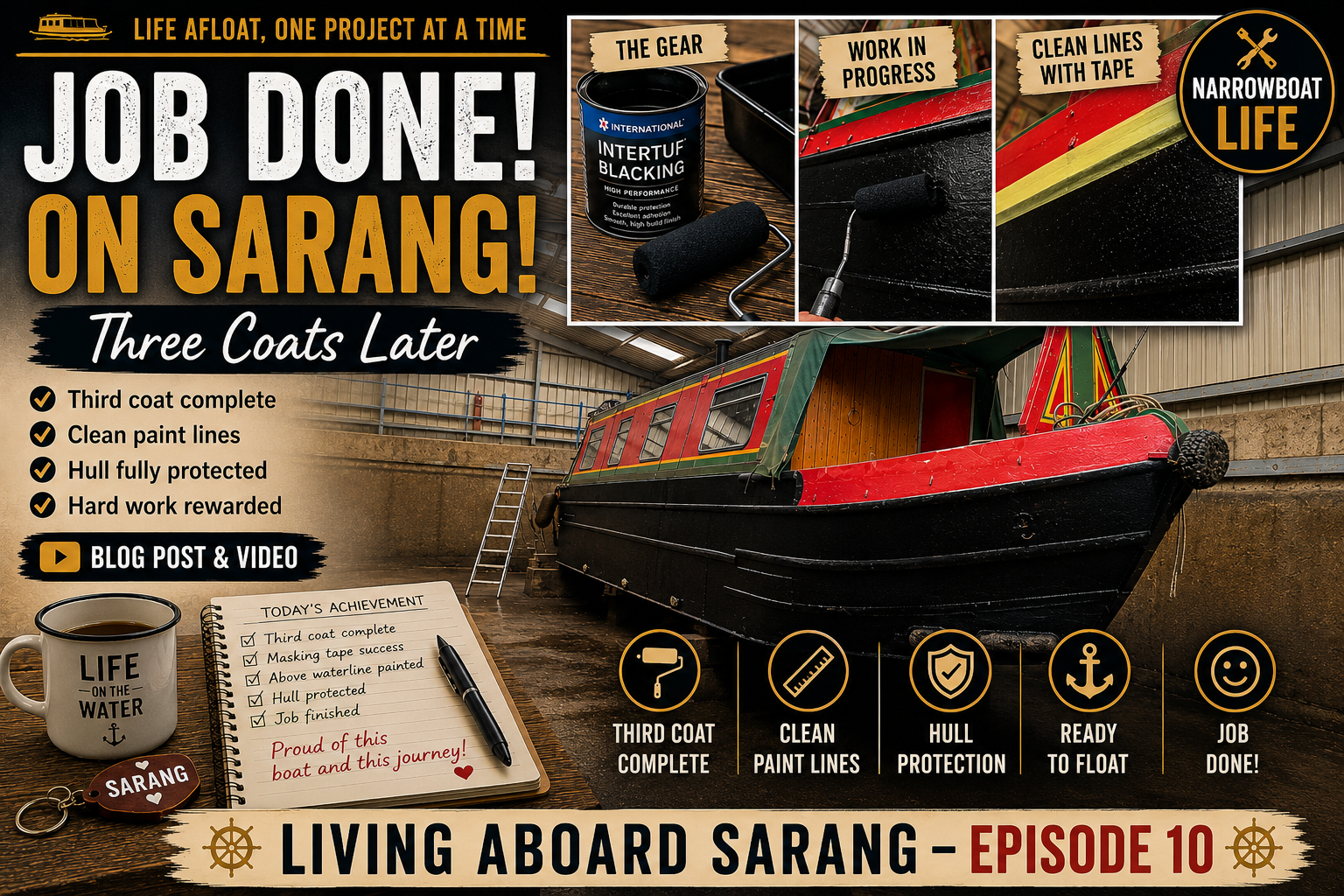
One of the biggest jobs I’ve undertaken since buying Sarang is finally complete.
Three evenings after work.
Three coats of blacking.
A lot of paint.
Quite a bit of aching.
And, if I’m honest, a huge sense of satisfaction.
When I first started this project, I wasn’t entirely sure what to expect. Like many first-time boat owners, I’d watched countless YouTube videos, read forums and spoken to experienced boaters, but none of that quite prepares you for actually standing in a dry dock with a roller in one hand and a tin of blacking paint in the other.
Now, standing back and looking at Sarang, I can honestly say I’m so pleased I decided to tackle it myself.
Back for the Final Coat
When I arrived back at the dry dock, the second coat had dried beautifully once again.
Just like the previous evenings, there was no paint coming off on my fingers and everything had cured exactly as I’d hoped.
That was a huge confidence boost.
The plan for tonight was straightforward.
Finish the third coat below the waterline.
Then, if everything went to plan, continue slightly above the original waterline to tidy the appearance of the hull and give the boat a little extra protection.
Finishing Below the Waterline
The roller made quick work of the third coat.
By now I’d developed my own little system.
One of the challenges with applying multiple coats of black paint is keeping track of where you’ve already been.
Black on black doesn’t exactly make things obvious!
Fortunately, I’d found a couple of natural reference points on the hull, allowing me to work methodically around the boat without missing any sections.
By the time I’d finished the final coat below the waterline, I knew the hull now had the protection I’d been aiming for from the very beginning.
Time for an Experiment
The next job was something I’d been thinking about throughout the project.
Rather than stopping exactly at the old paint line, I wanted to continue the fresh black coating slightly higher.
Not only would it give a cleaner appearance, but it would also offer a little more protection to the steel above the normal waterline.
There was only one concern.
Keeping the paint line neat.
So, armed with a roll of masking tape, I decided to give it a try.
I’ll admit I was slightly nervous.
Once tape goes onto old paintwork, there’s always the chance it could lift some of the existing paint away.
Thankfully, after a small test area, everything looked fine.
So I carried on.
A Surprisingly Good Result
It certainly wasn’t the prettiest masking job you’ve ever seen.
The tape wasn’t perfectly straight.
Some sections looked a little rough.
But that’s the beauty of masking tape.
It doesn’t have to look pretty while it’s on.
It simply has to do its job.
And it did exactly that.
Once the paint had been applied and the tape carefully peeled away, I was left with crisp, clean lines all the way around the hull.
I couldn’t have been happier.
Standing Back
After several evenings of work, I finally stepped back and looked at Sarang.
The transformation wasn’t dramatic in the way a new paint colour might be.
But it looked cleaner.
Sharper.
Better cared for.
More importantly, I knew exactly what was underneath that fresh black finish because I’d put every coat there myself.
That’s something no invoice or contractor can ever give you.
A New Boat Owner’s Advice
If you’re watching this because you’re thinking about blacking your own boat, I’d simply say this:
Don’t be frightened.
It’s physical work.
It’s messy.
You’ll ache a little afterwards.
But it’s also incredibly rewarding.
If you’ve got access to a dry dock and you’re prepared to take your time, I’d genuinely encourage you to have a go.
You’ll learn more about your boat in three days than you probably will in three months of simply cruising.
What’s Next?
Now that the blacking is complete, Sarang can finally come out of the dry dock.
The next stage of the journey includes:
- Seeing the finished hull once fully dry.
- Returning Sarang to her mooring.
- Hull survey results.
- Planning the next improvements.
- Continuing to turn this little narrowboat into a comfortable floating home.
One project complete.
Many more to come.
But that’s exactly why I bought Sarang.
Every project teaches something.
Every challenge builds confidence.
And every day aboard feels a little more like home.
Liam & Sarang
Life afloat, one project at a time.
Leave a Reply