
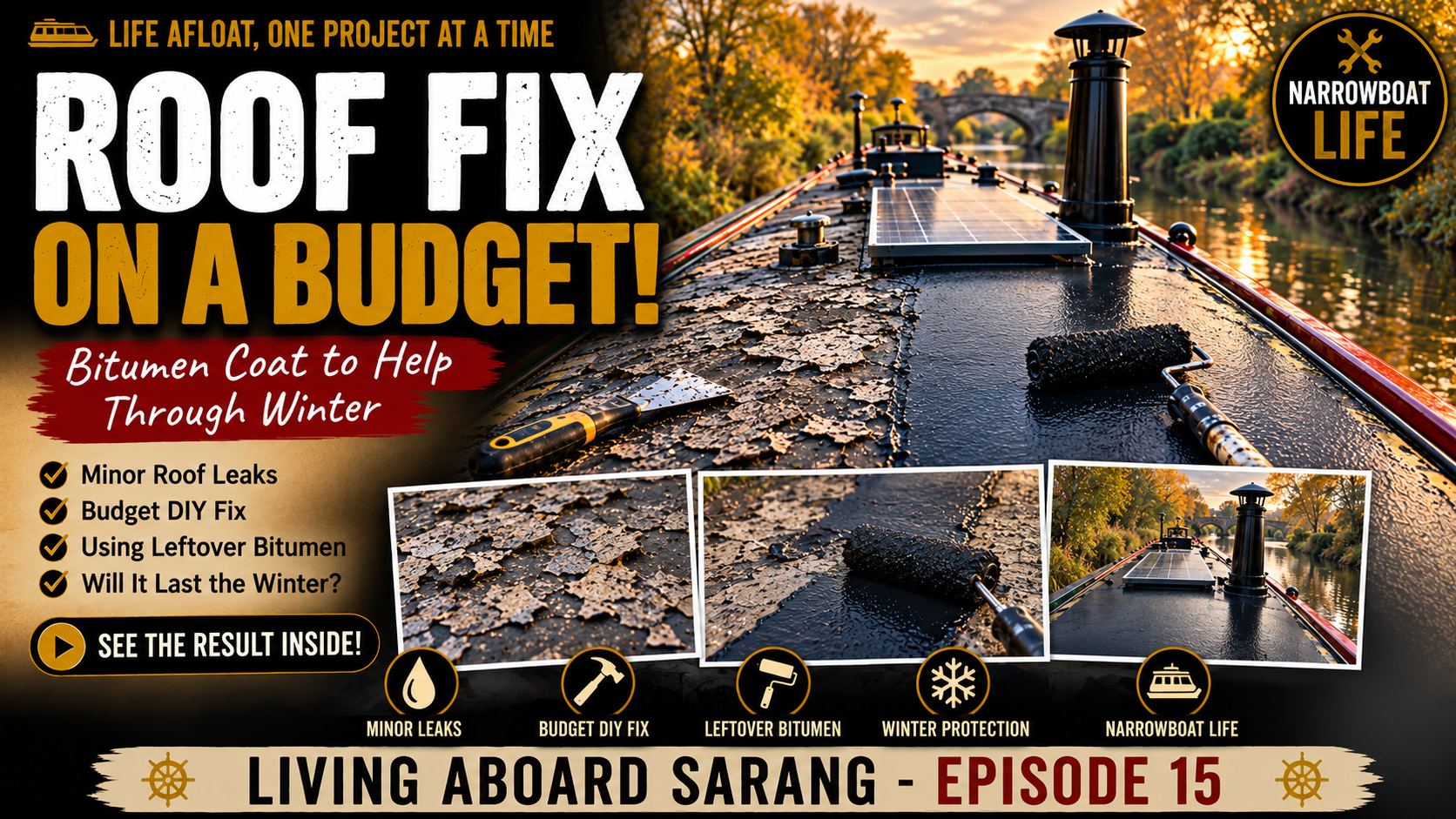
Owning an older narrowboat means there is always another job waiting to be done, and this time it was Sarang’s roof.
I’ve mentioned before that I have a few very minor leaks coming through the roof. Nothing dramatic — we’re certainly not talking waterfalls — but enough to make me think seriously about what I should do before the Scottish winter arrives.
I looked at several different options.
One idea was to cover the roof with aluminium. In theory, that sounded like a very good long-term solution, but once I started looking into the practicalities and the cost, it quickly became obvious that it wasn’t realistic for me at the moment. Because I don’t have the experience to install something like that myself, I would have needed professional help, and the overall cost could easily have run into thousands of pounds.
Steel was another possibility, but again there was the cost — and I also had concerns about adding unnecessary weight to the boat.
Then there was EPDM, the rubber membrane often used for roofing. I seriously considered this and it may still be something I revisit in the future. But installing it properly would mean cutting around the chimney, vents, solar panel and other fittings. For somebody who freely admits he isn’t exactly a DIY expert, it started to feel like quite a substantial project.
So I ended up choosing a much simpler solution.
Sometimes the simplest solution is the one you can actually do
A friend visited Sarang recently and pointed out something very obvious.
I still had bitumen paint left over from when I blacked the hull.
His suggestion was basically: why not use what you already have and coat the roof?
Now, I know this is one of those subjects where you can search online and find completely different opinions. Some people strongly advise against using bitumen on a narrowboat roof, while others have used it successfully.
I’m certainly not claiming that this is the perfect long-term solution.
What I am hoping is that it will protect the roof, reduce those small leaks and — most importantly — help get Sarang through another Scottish winter.
And because I already had the paint, the cost of trying it was virtually nothing.
First job: deal with the flaking
There was already old black coating on much of the roof, but some areas had begun to flake.
Armed with a fairly ordinary paint scraper, I started removing as much loose material as possible.
That turned out to be considerably harder than I expected.
Some sections came away relatively easily, while others were incredibly stubborn. I did my best to remove the loose material without creating even more mess, and because Sarang was still afloat throughout the entire job, I also tried to stop the flakes ending up in the canal.
Once I had prepared an area, I began applying the bitumen.
Rather than brushing it on like ordinary household paint, I used the brush almost in a stamping motion, trying to push the coating into the uneven areas of the roof.
Was it beautifully smooth?
Absolutely not.
But it started looking considerably darker and, hopefully, considerably better protected.
Working around the solar panel
One area I didn’t completely coat was underneath the solar panel.
I could probably have lifted it further, but remember that I was doing all of this while Sarang was floating.
The mental image of either myself or the solar panel disappearing into the canal was enough to convince me that discretion was probably the better option!
I painted underneath as far as I safely could and left the rest alone.
Sometimes you simply have to recognise your limits.
The plan for coat number two…
My original plan was straightforward.
Complete the first coat on Saturday, then come back on Sunday morning with my new extension roller and give the entire roof another coat.
Unfortunately, Scotland had other ideas.
When I got up on Sunday morning there was a huge amount of condensation covering the roof. It simply wasn’t dry enough to apply another coat safely.
Normally I would just wait for another suitable day, but this time there was an added complication.
I’m about to be away from Sarang for around three weeks, including two weeks abroad. By the time I return it will be early October — and anyone who knows Scottish weather will understand why that makes finding a dry roof-painting day considerably more difficult!
So, for now, Sarang has one substantial coat.
And I’m actually very pleased that I managed to get it done.
Is this the permanent answer?
Probably not.
I think that is one of the realities of owning something older, whether it is a boat, a car or even a house.
You constantly have to decide how much money to invest, what is genuinely necessary and what makes financial sense based on how long you intend to keep it.
I love Sarang, but spending hundreds or potentially thousands of pounds on a roof solution is still something I have to think carefully about.
For now, I already had the bitumen. I had the tools. I had a rare spell of reasonable Scottish weather.
So I used what I had.
The roof is considerably blacker, it looks more protected and, despite having bitumen on my arm by the end of the job, I’m glad I did it.
The real test will come over the next few months.
Will my budget roof fix keep Sarang dry through winter?
I suppose we’re going to find out together.
See you in the next episode.
Leave a Reply