
When I bought Sarang, I knew there would be plenty of jobs to do.
There would be maintenance, improvements, plenty of learning and, no doubt, a few mistakes along the way.
What I didn’t realise was just how satisfying it would be to stand back after completing one of those jobs and think…
“I did that.”
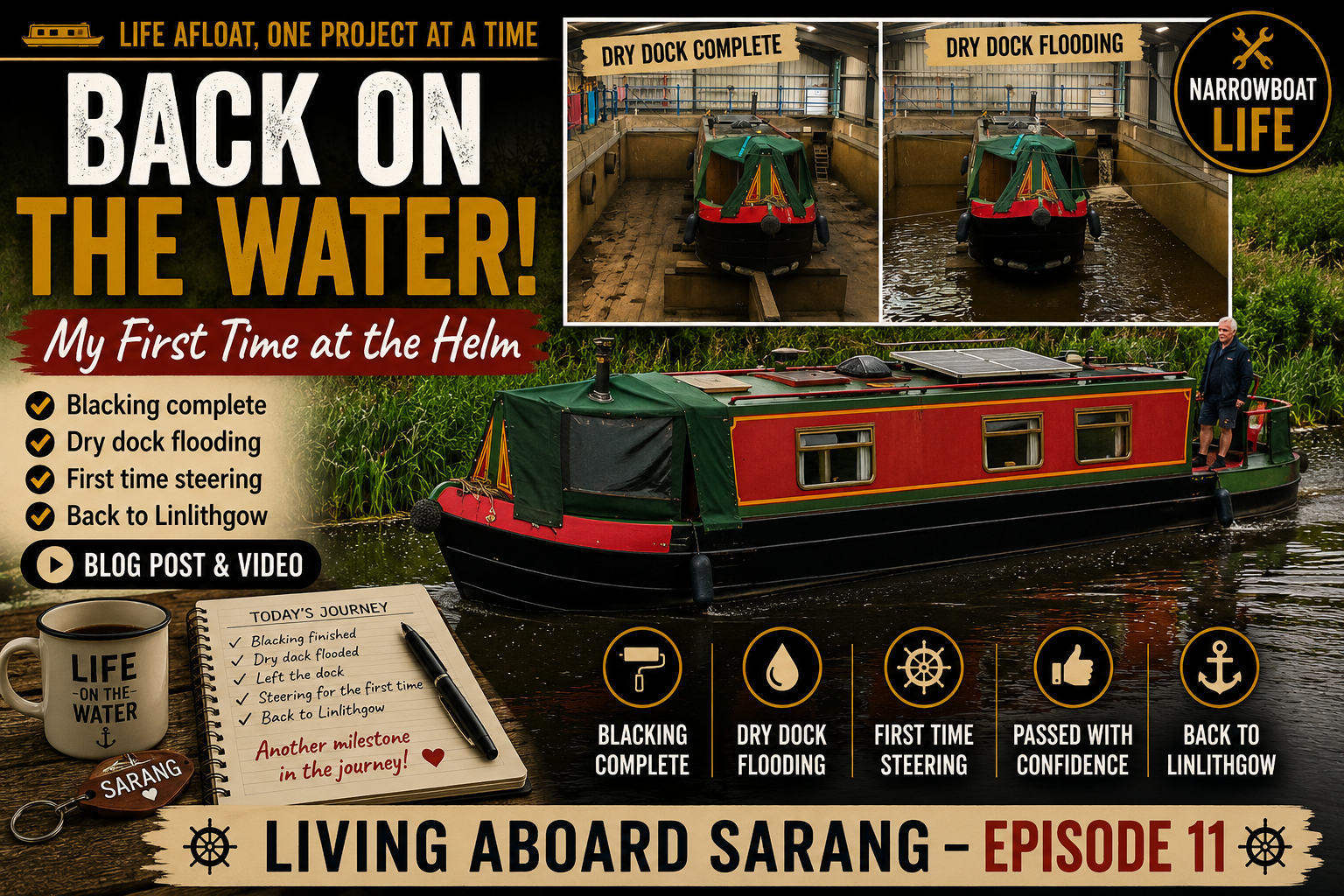
The blacking project is now finished.
Three coats have been applied to the hull, the paint has fully dried, and Sarang is looking better than she has in a very long time.
But before leaving the dry dock, I decided to try one final thing.
One Last Job
I hadn’t mentioned this in the previous videos because, quite honestly, I wasn’t sure if it would work.
I’d bought a long-handled roller with an extension pole and thought…
“Why not see if I can reach underneath the hull?”
Without lights underneath the boat it was almost impossible to see exactly what I was doing.
I can’t honestly say how effective it was.
Maybe I covered everything.
Maybe I missed a few spots.
But I figured something was better than nothing.
Sometimes that’s all you can do.
A Long Evening
By the time I’d finally packed everything away it was around nine o’clock in the evening.
I’d been painting almost continuously since just after seven.
I was absolutely exhausted.
There’s a difference between working hard and working physically.
Blacking a narrowboat definitely falls into the second category.
My plans for the evening suddenly became very simple.
A cold drink.
A Pot Noodle.
A hot shower.
Then bed.
Sometimes that’s all you need.
Worth Every Minute
The following day I came back to inspect the finished hull.
Standing there looking at Sarang, I couldn’t stop smiling.
The fresh black finish has completely transformed the appearance of the boat.
It’s amazing what clean paint can do.
Yes, the cabin sides will eventually need repainting.
The red.
The green.
The yellow coachlines.
That’s all work for another visit to the dry dock.
But now I know exactly how the process works.
Next time I’ll plan the week differently, book a few days off work and hopefully complete even more.
That’s one of the biggest lessons this project has taught me.
Boat ownership isn’t just about doing jobs.
It’s about learning how to do them better next time.
Time To Leave Dry Dock
Eventually the moment arrived.
The dry dock gates were closed.
The pumps were switched on.
Water slowly began filling the dock once again.
Watching Sarang gradually float free from the blocks she’d been resting on all week was surprisingly exciting.
It somehow marked the end of one chapter and the beginning of another.
Soon the gates would open.
It would be time to head back onto the canal.
My First Time At The Helm
The return journey wasn’t just another boat trip.
This time, I was behind the tiller.
For the very first time.
I’ll be honest…
I was nervous.
Very nervous.
Thankfully, my neighbour—who had kindly helped move Sarang to the dry dock in the first place—was there beside me, calmly talking me through everything.
Then came my first real challenge.
Passing another boat.
As we approached, I was trying to work out exactly what everyone else seemed to instinctively know.
Were they moving?
Were they waiting?
Should I slow down?
Should I continue?
Thankfully, my instructor for the afternoon remained wonderfully calm.
He explained exactly what the other skipper was doing, what I should be looking for, and reassured me that everything was perfectly under control.
A wave from the other boater.
A thumbs up in return.
And suddenly…
We’d passed safely.
I couldn’t help smiling.
It might seem like a very small thing to experienced boaters.
To me…
It felt enormous.
Confidence Comes One Journey At A Time
Boat ownership isn’t something you master overnight.
It’s built one journey…
One project…
One conversation…
One mistake…
And one success at a time.
Leaving the dry dock wasn’t just the end of the blacking project.
It was the beginning of learning how to become a proper narrowboat owner.
And I can’t wait for whatever comes next.
Liam & Sarang
Life afloat, one project at a time.
Leave a Reply